Expand description
§Two dimensions
Cartesian, two space dimensions. The kernels are the one-dimensional ones, applied along each axis
(see Numerical methods), so the one-dimensional validation carries
over, and this page adds what only appears with a second axis: transverse invariances, symmetry, splitting error and
flows with no exact solution. Problem files are in problems/2d/; test paths are relative to
crates/merlin-finite-volume/tests/ unless they start with crates/. All runs use one thread.
| Case | Reference | Headline result |
|---|---|---|
| 1D embedded in 2D | the 1D results | 1D embedded in 2D equals the 1D run bit for bit |
| Diagonal advection | exact translation | order 1 (upwind) and 2 (MUSCL, Strang Lax-Wendroff) |
| Isentropic vortex | exact smooth solution | order 2.11 |
| Planar shock | Rankine-Hugoniot | position within 0.05 cell |
| Lax-Liu configuration 3 | symmetry, conservation | asymmetry 0 |
| Lax-Liu configuration 6 | published pattern | HLLC keeps slip lines sharper |
| Shock-bubble | invariants | symmetric to 4e-14, mass balance exact |
§One dimension embedded in two
The 2D code must reduce to the 1D code. Four tests compare them exactly:
- the 2D flux with no transverse flow is bit-identical to the 1D flux
(
equations/euler_multid.rs:the_two_dimensional_flux_reduces_to_the_one_dimensional_one_without_transverse_flow); - Sod’s tube embedded in 2D along either axis is the 1D tube
(
sods_tube_along_either_axis_is_the_one_dimensional_tube); - reversing the transverse velocity reverses only the transverse flux, and a transverse boost adds only the kinetic energy it must
(
reversing_the_transverse_velocity_reverses_only_the_transverse_flux,a_transverse_boost_adds_only_the_kinetic_energy_it_must); - a problem that varies along one axis only is the one-dimensional problem
(
solver/multidim.rs:a_problem_that_varies_along_one_axis_is_the_one_dimensional_problem).
§Diagonal advection
A wave advected along the diagonal of a periodic square (problems/2d/advection/diagonal.toml), 2D upwind and MUSCL, and
Lax-Wendroff with Strang splitting (advection/lax_wendroff.toml).
- Upwind converges at order 1, MUSCL at order 2, and Lax-Wendroff with Strang splitting at order 2.
- Lax-Wendroff is refused without splitting, because the scheme contains the time step of one direction; a problem file asking for it
is rejected with a message naming
numerics.method. - Every method conserves the total to round-off, the unsplit method treats the two axes alike, and the results do not depend on the block layout. A 3D version follows the diagonal and conserves.
Tests that enforce this
Enforced by solver/multidim.rs: diagonal_advection_converges_at_first_order_with_upwind,
diagonal_advection_converges_at_second_order_with_muscl, lax_wendroff_is_second_order_in_two_dimensions_with_strang_splitting,
lax_wendroff_is_refused_without_splitting_in_two_dimensions, every_method_conserves_the_total_to_round_off,
the_unsplit_method_treats_the_two_axes_alike, the_time_step_follows_the_method, three_dimensional_advection_follows_the_diagonal_and_conserves.
§Isentropic vortex
A vortex of strength $\beta=5$ on the periodic square $[-5,5]^2$ carried by the uniform flow $(1,1)$ returns to its starting position
after $t=10$ (euler/vortex.toml, 100 by 100 cells, 4 blocks). Density, velocity and pressure are all advected unchanged: an exact smooth solution of the Euler
equations (Shu 1998; Hu and Shu 1999), so it measures the order of accuracy in two dimensions. The reference and the initial data use values at cell
centres.
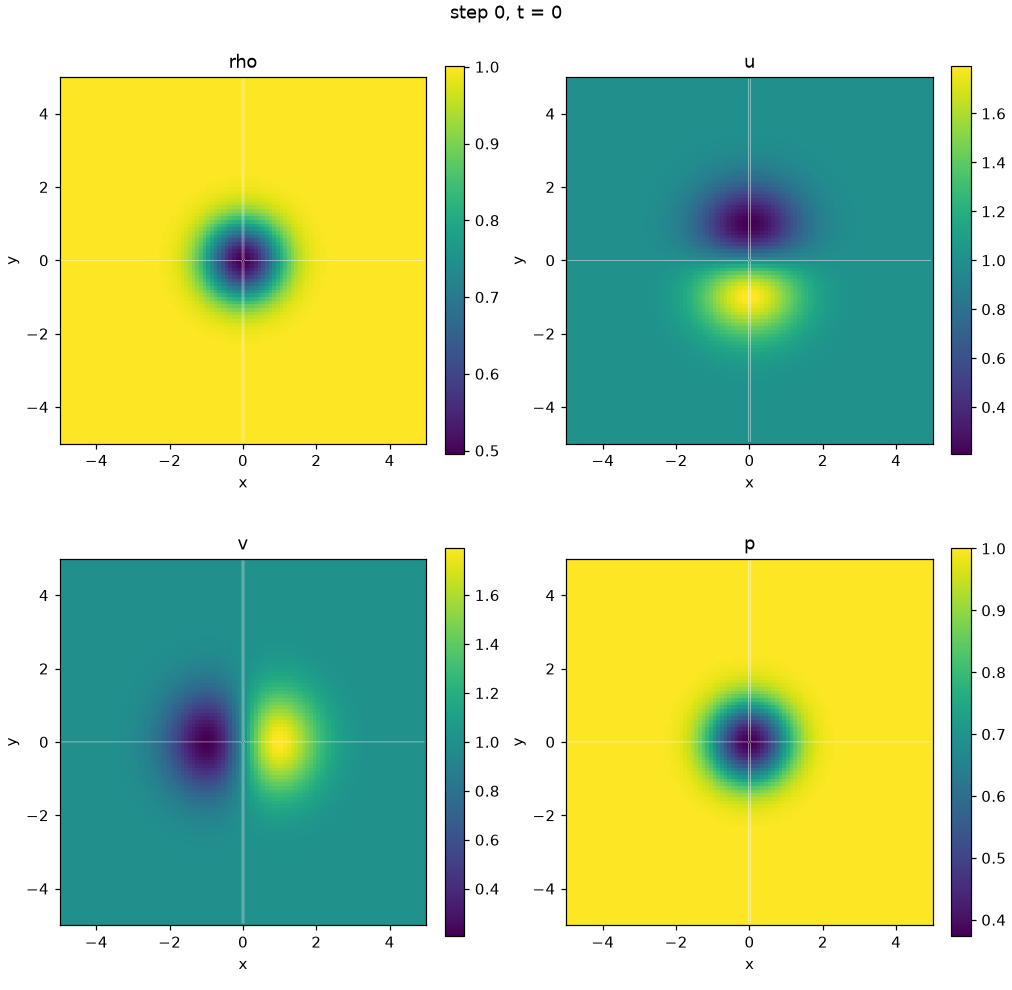
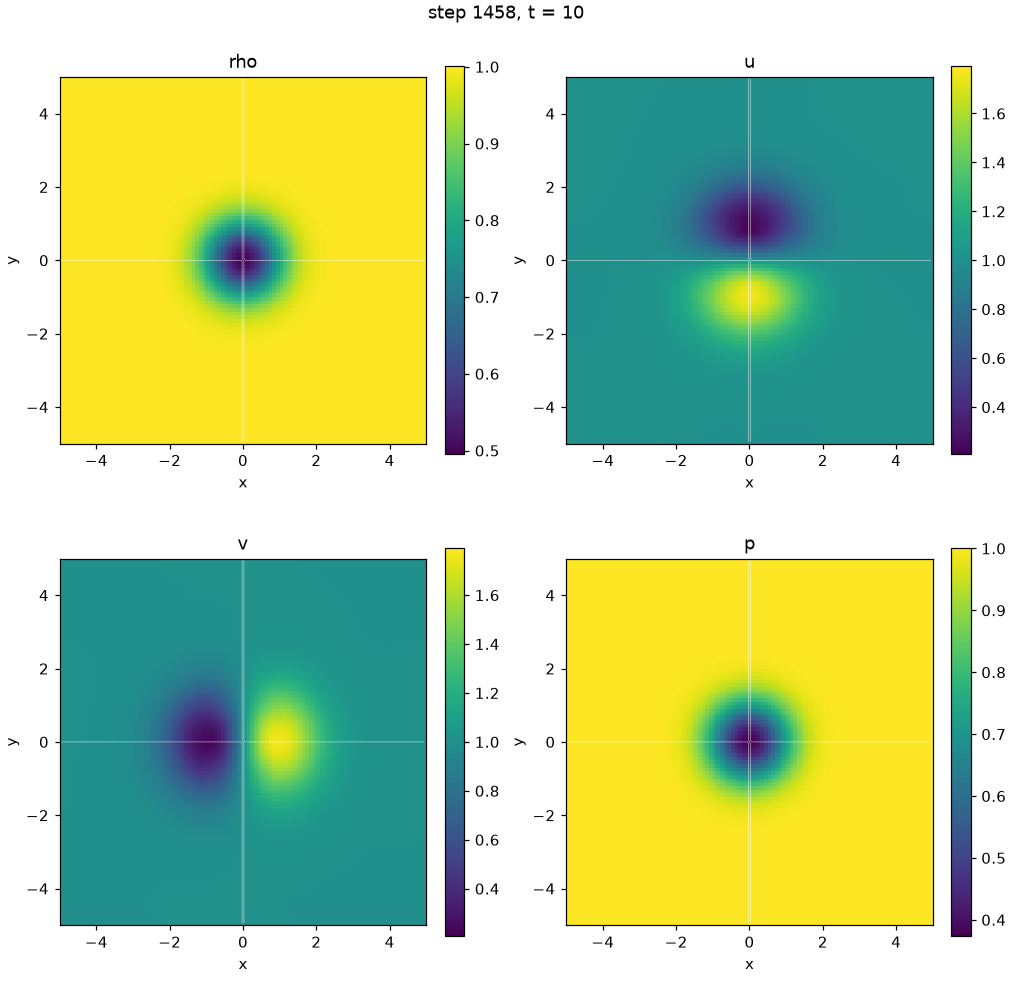
- Mean absolute density error per cell at
$t=1$: 1.90e-3 (32 cells) and 4.39e-4 (64 cells), observed order 2.11. - Over the full period, mass, both momenta and energy drift by 9e-14.
Tests that enforce this
Enforced by equations/euler2d.rs: the_isentropic_vortex_converges_at_second_order,
the_vortex_is_carried_without_changing_the_conserved_totals;
crates/merlin-cli/tests/run/multidim_problems.rs: the_shipped_vortex_conserves_everything_and_stays_smooth.
§Planar shock
A Mach 1.22 shock in a long thin channel (200 by 8 cells), driven by a fixed post-shock inflow, both split and unsplit. The post-shock state follows from Rankine-Hugoniot, and the shock speed from the mass balance.
- The shock sits within 0.05 of a cell of the Rankine-Hugoniot position.
- The plateau behind it is the post-shock state to 1e-3, and no transverse velocity appears.
Tests that enforce this
Enforced by equations/euler2d.rs: a_planar_shock_travels_at_the_rankine_hugoniot_speed.
§Lax-Liu configurations 3 and 6
Two of the 19 genuinely different two-dimensional Riemann problems of Lax and Liu (1998), four constant states one per quadrant of the unit square
(euler/riemann_config3.toml, euler/riemann_config6.toml; 200 by 200 cells, $t=0.5$). They have no exact solution, so only what can be derived is asserted,
and the pictures are for comparison with the published figures.
The initial states of the two configurations, one per quadrant (drawn with equal quadrants; the crossing is at $(0.8,0.8)$ for configuration 3 and $(0.5,0.5)$ for configuration 6). Each of the four interfaces launches a 1D wave fan like the one-dimensional one: a shock in configuration 3, a contact in configuration 6.
Configuration 3 (four shocks meeting at $(0.8,0.8)$, as set up by Kurganov and Tadmor 2002):
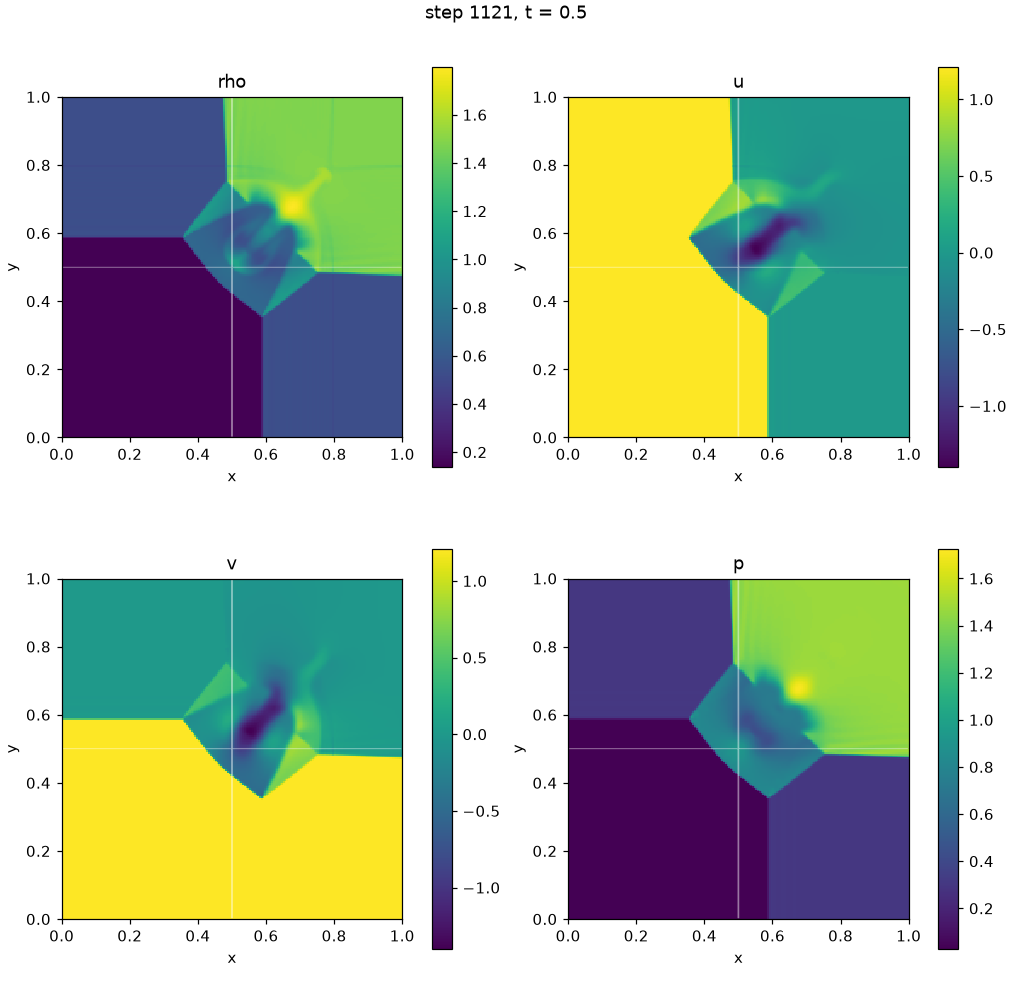
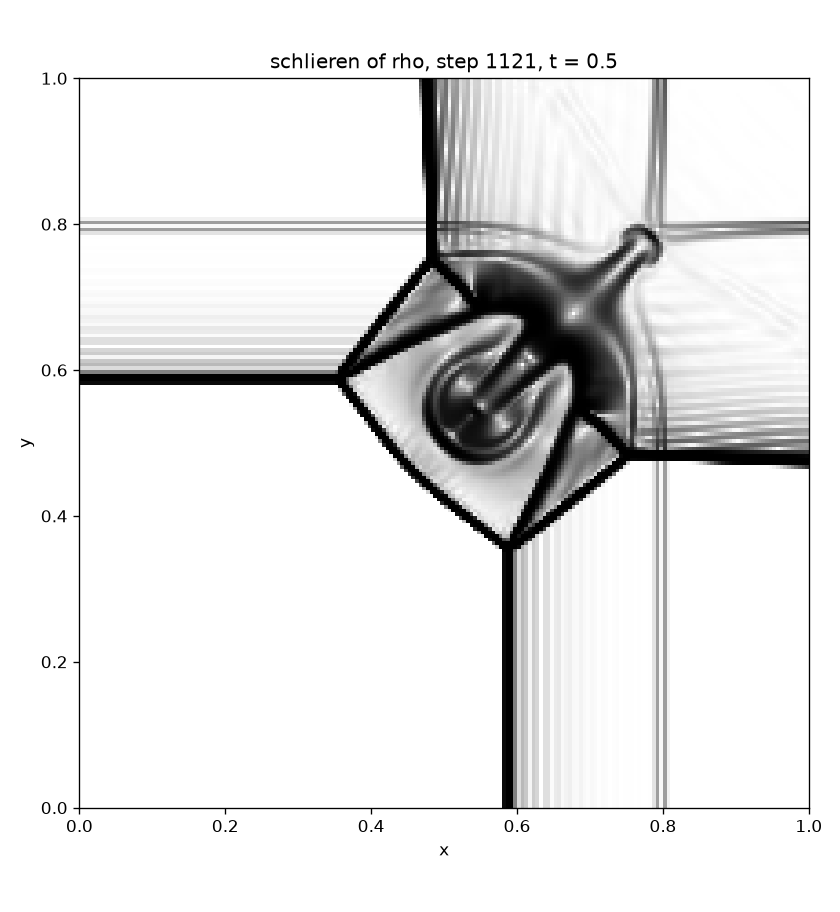
- Exact symmetry about the diagonal (asymmetry 0, at 64 by 64 and 200 by 200, unsplit).
- The lower-left corner keeps its initial state (density 0.138).
- Split and unsplit agree to 1e-7 in mean density, and pointwise within 2.4 % of the peak density at 200 by 200.
- The solution converges as the grid is refined.
Configuration 6 (four slip lines):
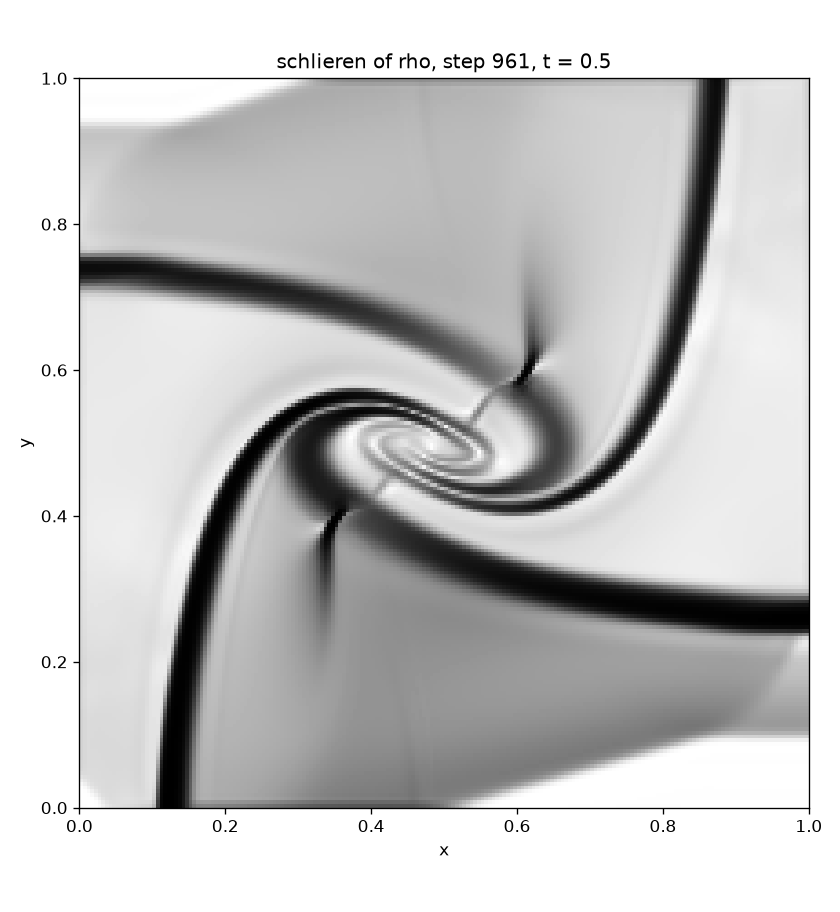
The slip lines roll up into the expected spiral, and HLLC keeps them sharper than HLL (steepest density jump 17 % larger).
Tests that enforce this
Enforced by equations/euler2d.rs: configuration_3_stays_symmetric_about_the_diagonal_and_physical,
configuration_3_converges_as_the_grid_is_refined, split_and_unsplit_solutions_agree_on_configuration_3,
configuration_6_slip_lines_are_kept_sharper_by_hllc_than_by_hll, the_unsplit_method_is_exactly_symmetric_under_swapping_the_axes;
crates/merlin-cli/tests/run/multidim_problems.rs: the_shipped_riemann_problem_is_symmetric_about_the_diagonal.
§Shock-bubble interaction
A Mach 1.22 shock hits a disc of density 0.138 in pressure equilibrium (euler/shock_bubble.toml, 400 by 100 cells on $[0,2]\times[0,0.5]$,
$t=2$; Haas and Sturtevant 1987; Quirk and Karni 1996). The bubble here is the same gas at a lower density, a stand-in for their helium
bubble, which needs two materials. The problem is symmetric about $y=0.25$.
The set-up. The shocked region fills $0\le x\le0.25$; the bubble has the same pressure as the gas around it.
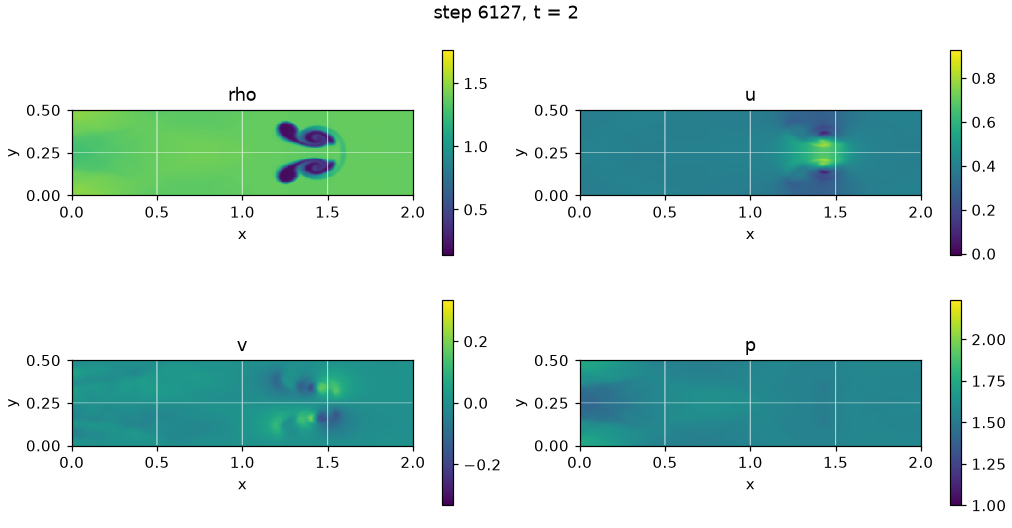
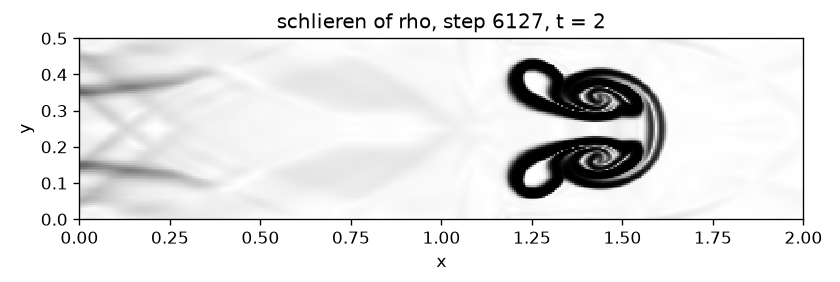
- The mass gained equals the inflow through the fixed end; density and pressure stay positive.
- Symmetric about the mid-line to 4e-14.
- The bubble edge converges under refinement.
Tests that enforce this
Enforced by equations/euler2d.rs: the_bubble_problem_balances_mass_stays_symmetric_and_physical,
the_bubble_position_converges_under_refinement; crates/merlin-cli/tests/run/multidim_problems.rs:
the_shipped_shock_bubble_stays_symmetric_about_its_axis.
§What holds in every 2D problem
- Block layout and threads: any layout and any thread count gives the same bits (
equations/euler2d.rs:results_do_not_depend_on_the_block_layout;solver/threads.rs:a_two_dimensional_gas_is_identical_on_any_number_of_threads_for_every_boundary). - Conservation: closed boxes conserve mass and energy to round-off (
closed_boxes_conserve_mass_and_energy_in_two_dimensions). - Restart: a restarted 2D run ends where the uninterrupted run does, bit for bit, split and unsplit
(
crates/merlin-driver/tests/drive/restart.rs:two_dimensional_euler_restarts_exactly_with_strang_splitting,two_dimensional_euler_restarts_exactly_unsplit).
§References
- Lax, P. D. and Liu, X.-D. (1998), Solution of two-dimensional Riemann problems of gas dynamics by positive schemes, SIAM J. Sci. Comput. 19.
- Kurganov, A. and Tadmor, E. (2002), Solution of two-dimensional Riemann problems for gas dynamics without Riemann problem solvers, Numer. Methods Partial Differential Equations 18.
- Shu, C.-W. (1998), lecture notes in Advanced Numerical Approximation of Nonlinear Hyperbolic Equations, Springer LNM 1697; Hu, C. and Shu, C.-W. (1999), Weighted essentially non-oscillatory schemes on triangular meshes, J. Comput. Phys. 150.
- Haas, J.-F. and Sturtevant, B. (1987), Interaction of weak shock waves with cylindrical and spherical gas inhomogeneities, J. Fluid Mech. 181; Quirk, J. J. and Karni, S. (1996), On the dynamics of a shock-bubble interaction, J. Fluid Mech. 318.