Expand description
§Spherical coordinates
The Euler equations in spherical symmetry: a one-dimensional radial problem (geometry = "spherical"). The geometric terms are those of the
cylindrical case with face areas $4\pi r^2$ and volumes $\tfrac43\pi r^3$ per unit solid angle, and the validation
is the same set of questions. Problem files are in problems/spherical/. Test paths are relative to
crates/merlin-finite-volume/tests/ unless they start with crates/.
| Case | Reference | Headline result |
|---|---|---|
| Sound wave | exact linear solution $f(r-ct)/r$ | order 1.72, 1.67, 1.88 (MUSCL); tends to 1 without reconstruction |
| Noh’s implosion | exact | shock at 0.19875 (exact 0.2); plateau 63.12 (exact 64) |
| Sedov-Taylor blast | exact self-similar solution (in Python) | shock radius 0.69375 (exact 0.69096); error 2.6e-3 at 800 cells |
| Blast | a fine run in the same geometry | order 1.09 on the finest pair |
| Conservation | invariants | drift 1.1e-13 / 2.4e-13 |
§Outgoing sound wave
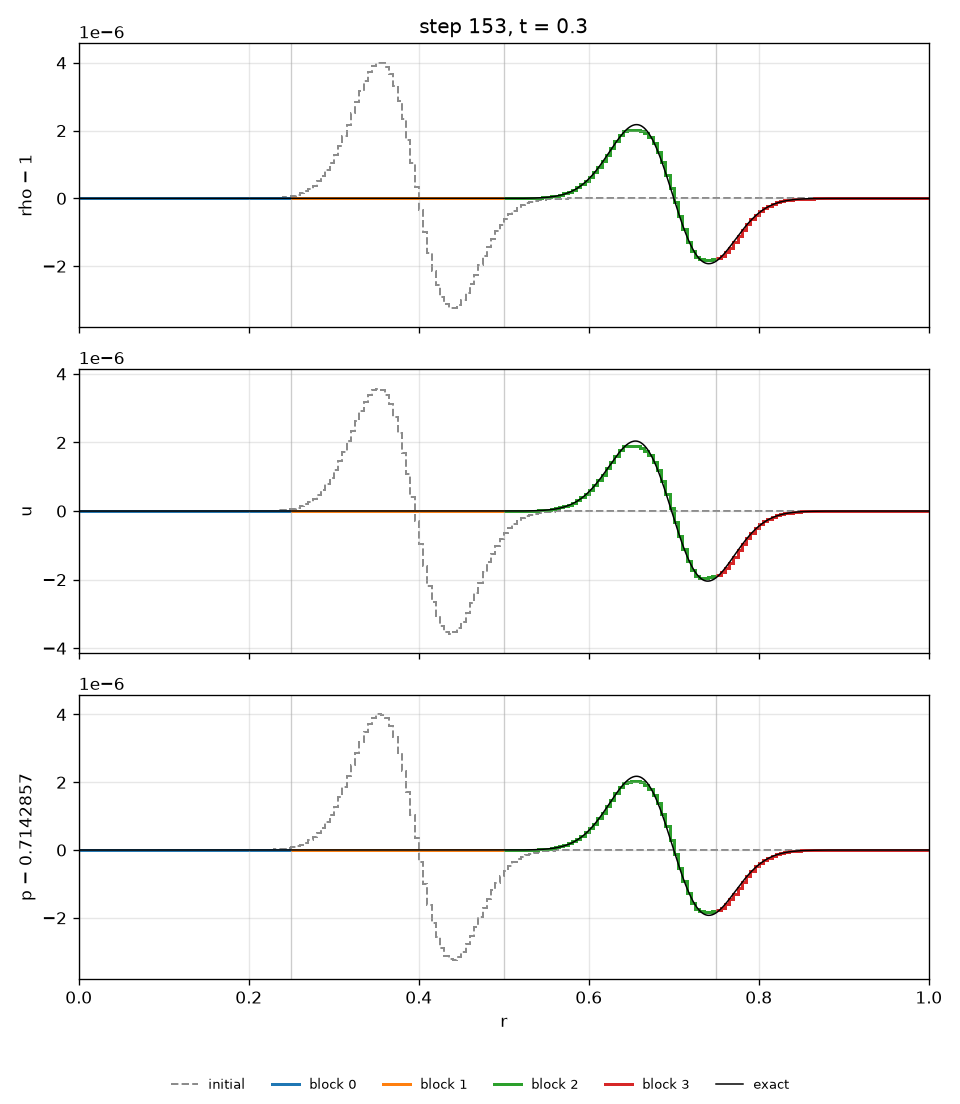
A spherical wave of small amplitude has the exact solution $p'=\rho_0 c\,f'(r-ct)/r$ from the potential $\varphi=f(r-ct)/r$
(Landau and Lifshitz, Fluid Mechanics, Section 69; Equations). It solves the nonlinear
equations up to terms of second order in the amplitude, which the relative amplitude $10^{-7}$ makes negligible. It is the Rust test of the radial source term: an inconsistent geometric term would show up as an error that does not shrink with the grid.
A Gaussian of width 0.06, $t=0.3$, HLLC, SSP-RK3; errors in units of the amplitude:
| Scheme | Cells | $L_1$ errors | Observed orders |
|---|---|---|---|
| MUSCL (van Leer) | 50, 100, 200, 400 | 1.246, 0.378, 0.119, 0.0323 | 1.72, 1.67, 1.88 |
| first order | 200, 400, 800, 1600 | 1.422, 0.875, 0.495, 0.265 | 0.70, 0.82, 0.90, tending to 1 |
The same wave computed through the Python reference (pymerlin convergence spherical/euler/acoustic, errors in units of the pulse) gives
5.24e-3, 1.65e-3, 4.46e-4, 1.09e-4 and orders 1.67, 1.88, 2.03, fitted 1.86, in agreement with the Rust test.
Tests that enforce this
Enforced by geometry/acoustic.rs: a_spherical_sound_wave_converges_at_second_order_with_muscl,
a_spherical_sound_wave_converges_at_first_order_without_reconstruction; and in continuous integration
pymerlin check --self-test acoustic and
pymerlin convergence spherical/euler/acoustic --expect-order=2 --tolerance=0.4.
§Noh’s implosion
The same exact problem as in the cylinder, with $\nu=3$. For $\gamma=5/3$ the post-shock density is
$4^3=64$ and the shock reaches $r=0.2$ at $t=0.6$ (spherical/euler/noh.toml, 400 cells).
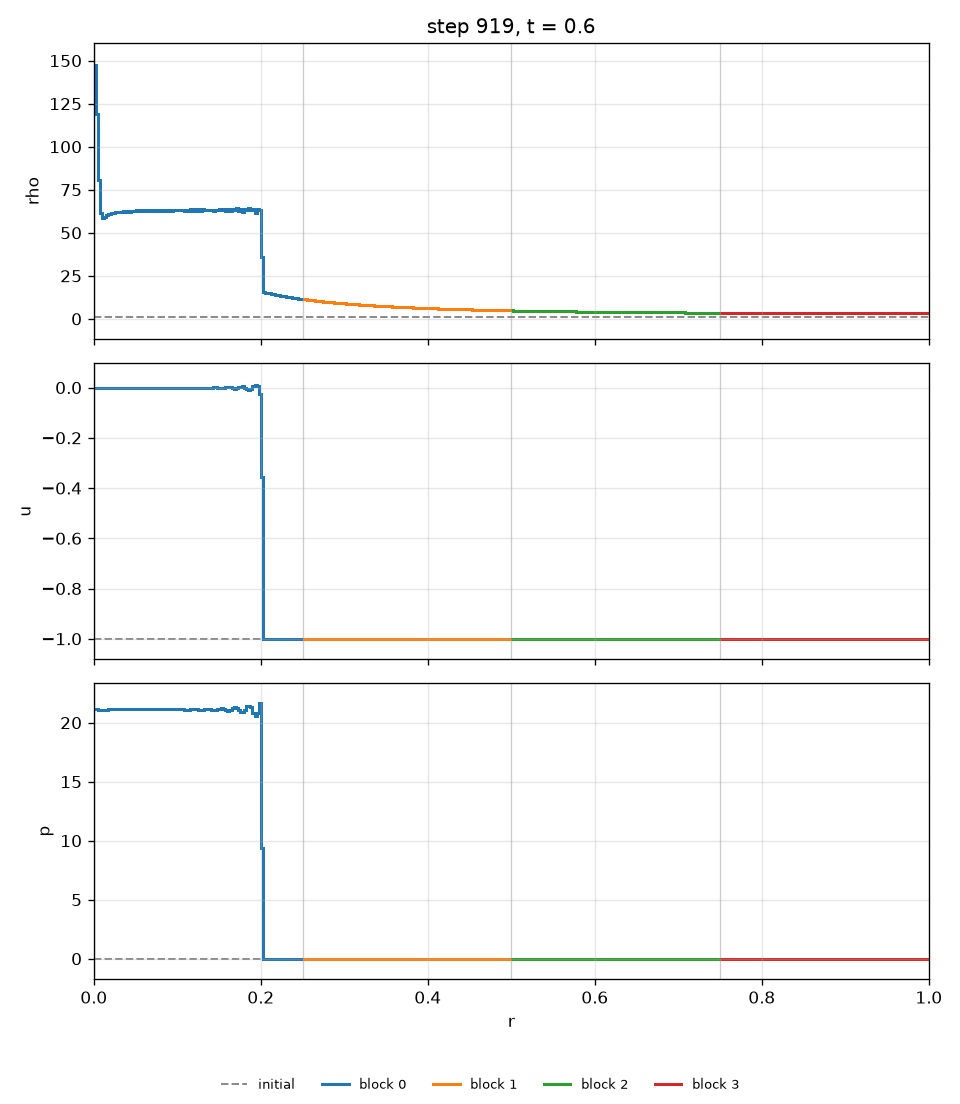
- Shock at 0.19875 against 0.2.
- Mean density behind the shock 63.12 against 64.
$L_1$density error over$0.05<r<0.35$at 100, 200, 400 cells: 0.649, 0.339, 0.178; observed orders 0.94, 0.93, a shock and the wall-heated centre limiting the order to about one.
Tests that enforce this
Enforced by geometry/noh.rs (parametrised over both geometries): the_density_behind_the_shock_is_the_exact_plateau,
the_shock_is_at_the_exact_radius, the_error_falls_as_the_grid_is_refined, muscl_is_more_accurate_than_first_order_on_the_implosion;
crates/merlin-cli/tests/run/curvilinear_problems.rs: noh_files_show_the_exact_gas_behind_the_shock.
§Sedov-Taylor blast
A hot ball of radius 0.02 ($p=10^4$ against $10^{-3}$, energy $E=0.838$) in a cold gas at rest drives a strong spherical shock. Once the shock is several radii of the
ball away, the flow is the self-similar solution of Sedov (1959), $R(t)=(Et^2/\alpha\rho_0)^{1/5}$ with $\alpha=0.85107$ for $\gamma=1.4$, which is Sedov’s
published 0.851; it is computed in Python (src/pymerlin/exact_solutions/sedov.py, derived on the
Equations page). 400 cells, $t=0.4$ (spherical/euler/sedov.toml):
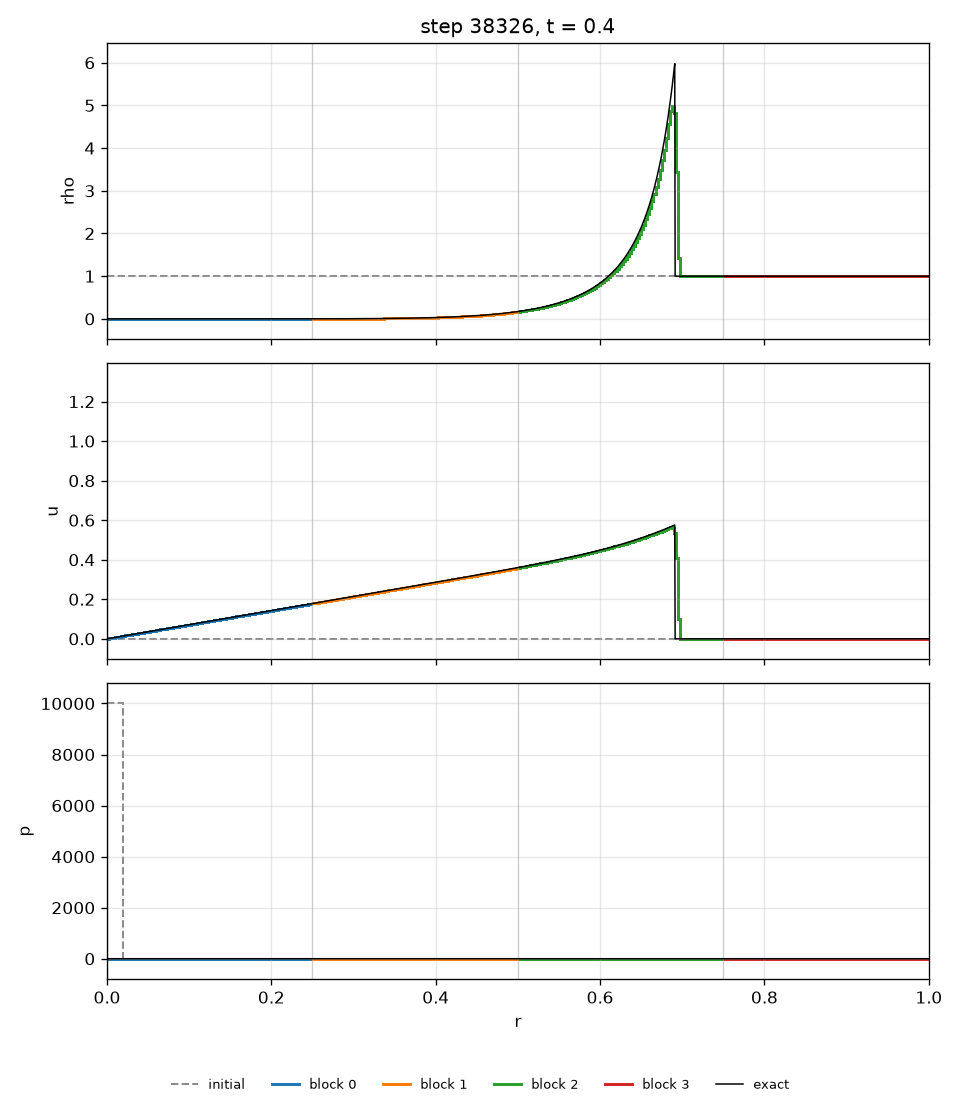
- Shock radius 0.69375 against 0.69096: 0.4 %, a little more than a cell.
- The density peak is 5.00 against the exact 6, from the smearing of the shock.
- Mass and energy drift 3.3e-13 and 2.3e-12.
$L_1$density error against the exact solution (units of the density range) at 100, 200, 400, 800 cells: 1.34e-2, 8.55e-3, 5.39e-3, 2.59e-3, observed orders 0.65, 0.67, 1.05 (fit 0.78).
As in the cylindrical case the check is a bound, not an order: the simulation starts from a ball of finite size, so the error does
not go to zero as the grid is refined. It is checked from Python, in continuous integration: uv run pymerlin check --self-test sedov and
uv run pymerlin convergence spherical/euler/sedov --max-error=0.005.
§Blast against a fine run
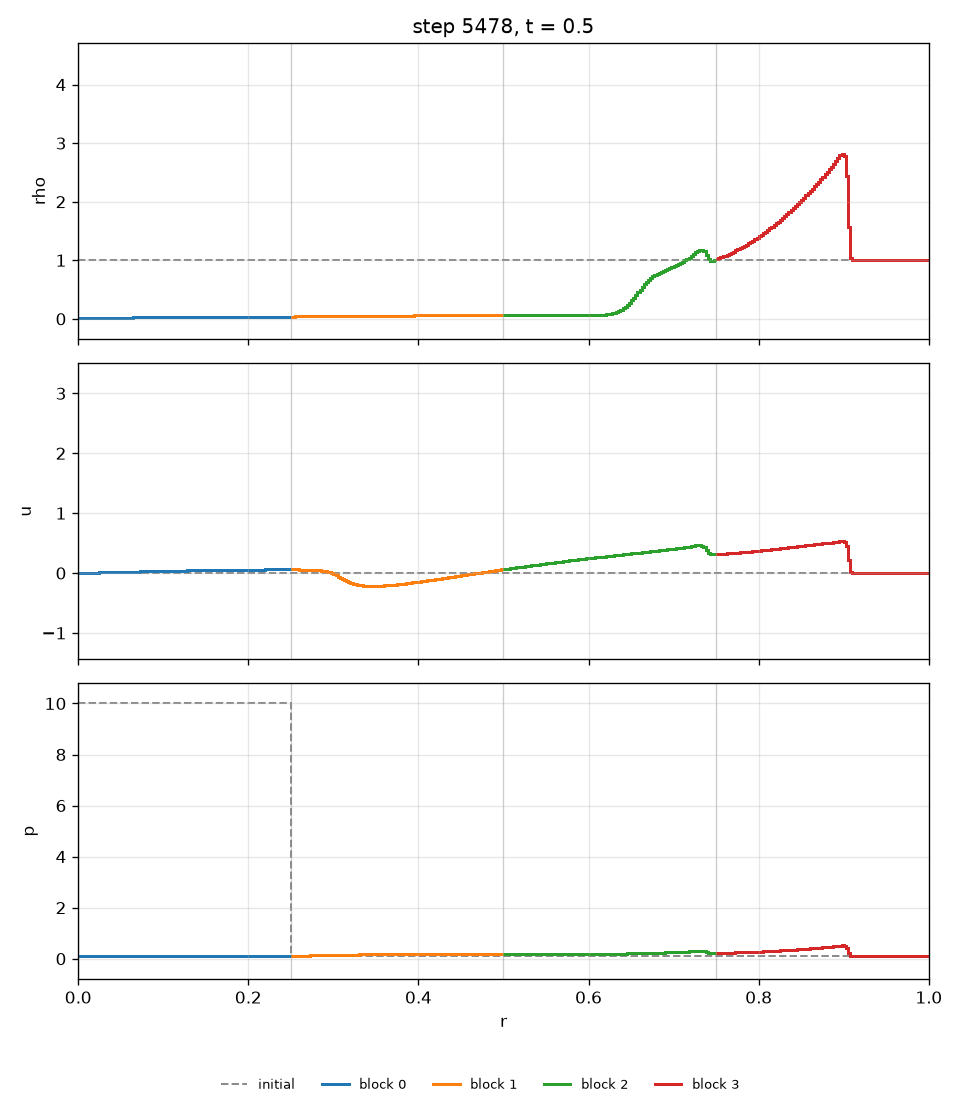
The hot core $r<0.25$ in a closed tube, $t=0.2$ (spherical/euler/blast.toml); the reference is a 1600-cell run in the same geometry.
| Cells | 50 | 100 | 200 | 400 |
|---|---|---|---|---|
$L_1$ density error | 6.9e-2 | 6.0e-2 | 3.4e-2 | 1.6e-2 |
Order 1.09 on the finest pair.
Tests that enforce this
Enforced by geometry/blast.rs: a_blast_converges_to_the_fine_run_in_the_same_geometry.
§Orders at a glance
Error against refinement for the spherical cases, each series divided by its own coarsest error. The exact profile of Noh’s implosion is on the cylindrical page.
§Conservation and equilibrium
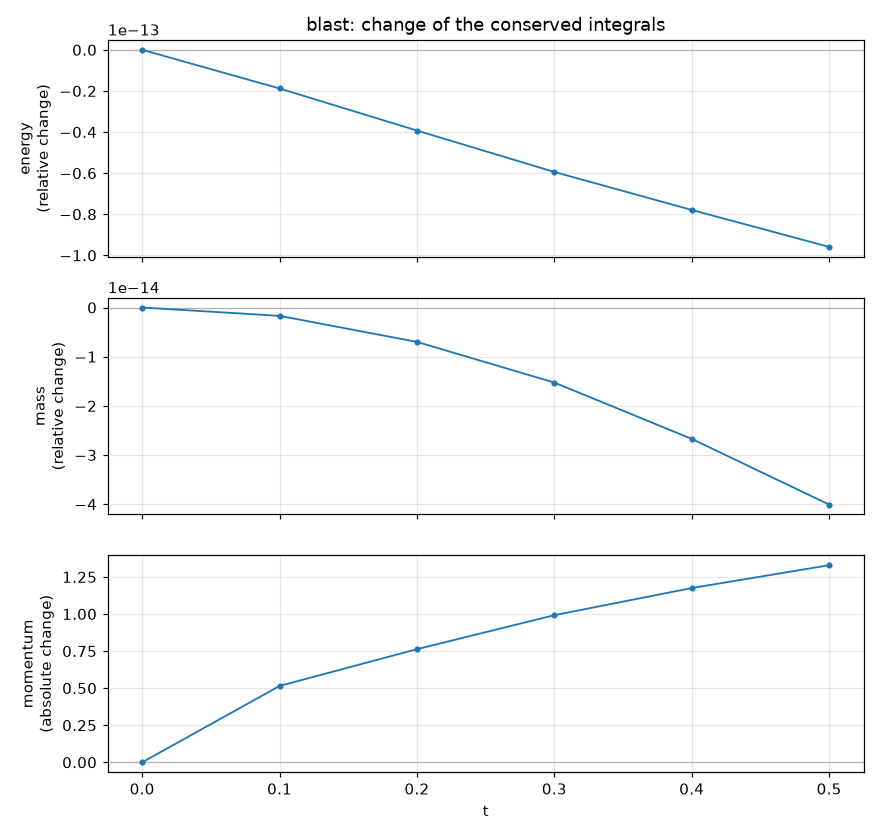
- A gas at rest has exactly zero right-hand side, as in the cylinder (
geometry/operator.rs). - A closed ball conserves mass and energy: relative drift 1.1e-13 and 2.4e-13 over
$t=0.5$with 400 cells (5478 steps), with the total mass$4\pi/3$required by the volumes (geometry/conservation.rs:a_closed_cylinder_or_ball_conserves_mass_and_energy;crates/merlin-cli/tests/run/curvilinear_problems.rs:closed_problems_conserve_the_volume_integrals_of_mass_and_energy). - Results do not depend on the thread count (1 to 8) or the block layout.
- A gas with swirl is refused on a spherical grid, because the swirl needs an axis to rotate about (
geometry/swirl.rs:swirl_needs_an_axis_to_rotate_about). - A strong outward flow at the centre keeps a positive density, because the time step accounts for the cell next to the centre, whose face area over volume is
$3/\Delta r$(geometry/conservation.rs:the_time_step_accounts_for_the_small_cells_next_to_the_axis,a_strong_outward_flow_at_the_axis_keeps_a_positive_density).
§References
- Noh, W. F. (1987), Errors for calculations of strong shocks using an artificial viscosity and an artificial heat flux, J. Comput. Phys. 72, 78-120.
- Landau, L. D. and Lifshitz, E. M., Fluid Mechanics, Sections 69 and 106.
- Sedov, L. I. (1959), Similarity and Dimensional Methods in Mechanics, Academic Press, Chapter IV.
- Toro, E. F. (2009), Riemann Solvers and Numerical Methods for Fluid Dynamics, Chapter 1.